
Luna Protocol: I created an autonomous Discord bot that simulates a human being
What if a Discord bot could sleep, make typos, hesitate, forget to reply, and sometimes send you a message on its own? That's exactly what Luna Protocol does: a fully autonomous Discord bot running a local LLM (llama.cpp) that converses like an imperfect human.
No rigid prompts, no robotic responses. Luna has a priority trigger system, variable delays, sleep schedules, spontaneous messages, and even a TTS pipeline for voice messages. All configured via a simple hot-reloadable config.yml.
In this article, we break down the complete architecture: from the generic event bus to the TTS pipeline, covering the trigger system, human-like components, and the fine-tuning dataset.

The architecture: a typed event bus
The heart of Luna is a TypedBus -- a strongly typed generic event bus in TypeScript. It's the fundamental building block everything rests on.
type EventMap = Record<string, unknown[]>;

export class TypedBus<Events extends EventMap> {
  private listeners = new Map<keyof Events, Set<(...args: unknown[]) => void>>();

  on<K extends keyof Events>(event: K, listener: (...args: Events[K]) => void): void {
    if (!this.listeners.has(event)) {
      this.listeners.set(event, new Set());
    }
    this.listeners.get(event)!.add(listener as (...args: unknown[]) => void);
  }

  emit<K extends keyof Events>(event: K, ...args: Events[K]): void {
    this.listeners.get(event)?.forEach((fn) => { fn(...args); });
  }
}
Two main buses derive from it:
llmBus-- handles LLM tokens, errors, crashes, resetstateBus-- handles state changes with automatic persistence
┌─────────────────────────────────────────────────────┐
│                   core/bus.ts                        │
│  TypedBus<K, V> -- on / off / once / emit            │
├──────────────────┬──────────────────────────────────┤
│   core/llm-bus   │       state/state-bus             │
│  token / done /  │     state:changed                 │
│  error / crash / │     → persistence auto            │
│  flush / ready / │                                   │
│  reset           │                                   │
└────────┬─────────┴────────┬─────────────────────────┘
         │                  │
┌──────────────────┐  ┌────▼──────────────────────┐
│ core/llm-core.ts │  │ bot.ts (Eris)             │
│ mode direct      │  │ bot/pending.ts             │
│   llama-server   │  │ bot/reactions.ts           │
│ mode online      │  │ state/trigger.ts           │
│   OpenAI API     │  │ state/state.ts             │
│                  │  │ behavior/*                 │
│                  │  │ tts/*                      │
│                  │  │ spontaneous.ts             │
└──────────────────┘  └────────────────────────────┘
The advantage of this approach: each module is decoupled from the rest. The LLM emits tokens on the bus, the bot consumes them, the state updates automatically. No circular dependencies.

The trigger system: who decides when Luna responds?
Every incoming message is evaluated by evaluateMessage() which returns a TriggerResult with a trigger reason. The priority order is critical:
| # | Reason | Conditions | Bypass ignore | Bypass pause |
|---|---|---|---|---|
| 1 | mention |
@bot | Yes (0%) | Yes |
| 2 | dm |
DM with replyInDM = true |
Yes (0%) | No |
| 3 | name |
"Luna"/"Pixie"/aliases (whole word) | No (8%) | No |
| 4 | keyword |
hello, hi, ai, bot... (whole word) |
No (8%) | No |
| 5 | follow-up |
Bot was last speaker + < 15s + < 3 / 60s | -- | -- |
| 6 | random |
1.5% chance on non-matching messages | No (8%) | No |
Matching is whole word (\b): "ai" does not match "mais", "vrai", "lait".

The follow-up mechanism
When Luna responds to a message, she registers as lastSpeaker. Any subsequent message within 15 seconds triggers an immediate response -- no timer, no keyword check. Budget: 3 follow-ups per 60-second window.
export function canFollowUp(channelId: string, botId: string): boolean {
  const recent = isRecentBotActivity(channelId);
  const speaker = lastSpeaker.get(channelId);
  const count = responseCount.get(channelId) ?? 0;
  return recent && speaker?.userId === botId && count < MAX_FOLLOWUPS;
}
The cooldown
8 seconds between two responses in the same channel. Bypassed by mentions and follow-ups.
Human-like behaviors: variable focus
This is where Luna gets interesting. Each trigger type has its own focus thresholds: a min/max delay, a chance to ignore, and a chance to react.
| Trigger | Delay min | Delay max | Ignore | React |
|---|---|---|---|---|
mention |
300ms | 1500ms | 0% | 8% |
dm |
400ms | 1800ms | 0% | 5% |
name |
800ms | 4000ms | 5% | 6% |
keyword |
1000ms | 3500ms | 8% | 4% |
follow-up |
500ms | 2000ms | 0% | 3% |
random |
1500ms | 5000ms | 15% | 2% |
The delay calculation also accounts for:
- Message length: the longer the message, the longer Luna takes to "read" it
- Inactivity: if Luna hasn't been active in 10 minutes, the delay is multiplied by 2 (simulating "waking up")
- Sleep: in
slowmode, the delay is multiplied by 3 to 5
export function computeDelay(
  reason: string | null = null,
  sleepBehavior?: string | null,
  msgLength?: number,
  inactivityMs?: number
): number {
  const t = getThresholds(reason);
  let delay = t.delay_min + Math.random() * (t.delay_max - t.delay_min);
  if (msgLength) {
    const readingFactor = Math.min(msgLength / 500, 3);
    delay *= 1 + readingFactor * (0.3 + Math.random() * 0.7);
  }
  if (sleepBehavior === "slow") {
    delay *= 3 + Math.random() * 2;
  }
  delay *= 0.5 + Math.random() * 1.5; // aggressive jitter
  return delay;
}
Sleep schedules
Luna can sleep. Configurable via config.yml:
timezone: "Europe/Paris"
time_schedules:
  - start: "00:00"
    end: "07:00"
    behavior: sleep
  - start: "23:00"
    end: "00:00"
    behavior: slow
  - start: "07:00"
    end: "08:00"
    behavior: short
| Mode | Effect |
|---|---|
sleep |
Only mentions and DMs go through |
slow |
Delay x3-5, reactions nearly zero |
short |
Ignore chance +30%, reactions nearly zero |
During sleep hours, the Discord status switches to invisible.
Typos
Luna can make typos -- and correct them after 2-4 seconds. The keyboard layout is configurable (AZERTY or QWERTY).
const azertyAdjacent: Record<string, string[]> = {
  a: ["z", "q", "w"],
  z: ["a", "e", "s", "x"],
  e: ["z", "r", "d", "s"],
  // ... all adjacent keys
};
AZERTY example: bonjour -> bonjpur, salut -> slaut, comment -> cpmment.
Three correction styles:
| Style | Behavior |
|---|---|
edit |
Edits the message |
message |
New message: word* |
mixed |
50/50 random (default) |
Hesitations and forgetfulness
Hesitations: 15% chance to start with a filler word (uh..., um..., well..., hmm..., so...).
Forgetfulness: even after matching a trigger, Luna can "forget" to respond with a 3% probability. No message, no reaction -- as if she saw nothing.
Thematic fatigue: if a word appears too often in the last 10 messages (threshold: 3 occurrences), delays are multiplied and the ignore chance increases by 15%.
Realism in practice: when it gets unsettling
On paper, all these systems (delays, typos, hesitations, forgetfulness) sound like gimmicks. In practice, combined together, the result is startling -- to the point that people talking with Luna have no idea. Here's a real exchange where someone directly asks Luna if she's a bot, and the conversation then drifts into a completely different topic with a naturalness that's honestly unsettling.

The tone, the hesitations, the pacing of the replies -- nothing gives away a bot. Luna deflects the age question without ever breaking character.
The conversation keeps flowing naturally, with short, human replies ("okay, okay", "yay", "yayy") -- exactly the kind of messages a person would send on Discord.


What's unsettling isn't just that Luna "replies" -- it's that she holds a conversation, with apparent opinions, follow-ups, and a coherent train of thought from one message to the next. Without the trigger system, the concentration delays, and the hesitations described above, this illusion would collapse within a few messages.
Small plot twist: in the screenshots above, both accounts talking are instances of Luna. PixieGlow and Sujet d'SBlow aren't a human testing a bot -- they're two bots talking to each other, each one behaviorally "convinced" it's chatting with someone "normal". If reading the exchange above you assumed one of the two was human, congratulations -- you just fell for it exactly like anyone would on a real Discord server.
It's basically a practical version of the dead internet theory: this theory (originally a fairly fringe idea) claims that a growing share of online content and interactions is generated by bots rather than humans, to the point that the "real" human internet has become a minority. Long dismissed as exaggerated, it gets less and less absurd as systems like Luna Protocol show that simulating a credible human presence at scale doesn't take much compute or a huge model. Two instances of the same bot holding an extended conversation without ever giving themselves away is a pretty concrete glimpse of what a web mostly populated by bots talking to each other could look like.
The LLM pipeline: two modes
direct mode (default)
The bot sends requests directly to a local llama-server over HTTP. The model is shared, with prompt cache and 4 concurrent slots. Two PM2 processes: the LLM server and the bot client.
online mode
The bot calls any OpenAI-compatible API (OpenAI, OpenRouter, Groq, Together...). No local LLM required.
Real-time streaming
The LLM streams its response line by line (\n). Each line is split into words, emitted one by one on llmBus.emit("token", word). At each \n, a flush event is emitted -- the bot immediately sends the accumulated message. No simulated delay: the pace is the LLM's own.
function emitWordTokens(chunk: string): void {
  const words = chunk.match(/\S+/g) ?? [];
  wordEmitQueue.push(() => {
    let i = 0;
    const emitNext = () => {
      llmBus.emit("token", words[i]);
      i++;
      if (i < words.length) {
        const delay = MIN_WORD_DELAY + Math.random() * (MAX_WORD_DELAY - MIN_WORD_DELAY);
        setTimeout(emitNext, delay);
      } else {
        llmBus.emit("flush");
      }
    };
    emitNext();
  });
}
The request queue (requestQueue) processes requests one at a time, with automatic cleanup when the queue exceeds 100 items.
Spontaneous messages
Every 5 minutes, there is a 12% chance that Luna posts a message on her own. The server is selected by a linear weight system: the most active server has Nx more chances than the least active.
const total = (ranked.length * (ranked.length + 1)) / 2;
let roll = Math.random() * total;
for (let i = 0; i < ranked.length; i++) {
  roll -= ranked.length - i;
  if (roll <= 0) return ranked[i];
}
The context of the last 5 messages is read, and Luna joins the conversation "naturally".
The TTS pipeline: voice messages
With 8% chance, Luna sends a voice message instead of text. The complete pipeline:
- Piper TTS synthesizes the text to WAV
- ffmpeg converts to OGG
- The waveform is computed for the Discord preview
- The file is uploaded via the Discord CDN API
- The voice message is sent
export async function sendTextAsVoiceMessage(
  channelId: string, replyToMessageId: string, text: string
): Promise<void> {
  const safe = sanitizeForTTS(text);
  const { audio: wavBuf } = await synthesize(safe);
  const oggBuf = await wavToOgg(wavBuf);
  const durationSecs = await getAudioDuration(oggBuf);
  const waveform = buildWaveformBase64();
  const { uploadUrl, uploadFilename } = await requestUploadUrl(channelId, oggBuf.byteLength, durationSecs);
  await putFileToUploadUrl(uploadUrl, oggBuf);
  await postVoiceMessage(channelId, uploadFilename, durationSecs, waveform, replyToMessageId);
}

Anti-spam and persistence
Anti-spam
Queue per channelId:userId. One message per user per channel in queue. Processed as soon as the current response finishes.
Session limits
After 8 exchanges, Luna takes a 30-second break. The counter resets after 3 minutes of inactivity.
Automatic persistence
Every state mutation emits on stateBus -> automatic save (500ms debounce). No more manual saveAllState() calls. Persisted state includes: pendingMessages, paused, cooldowns, timestamps, lastSpeaker, follow-up counters.
Hot-reload configuration
A single config.yml file. Most values are hot-reloadable -- changes take effect without restart.
| Category | Hot-reload |
|---|---|
| Triggers, keywords, names | ✅ |
| Focus, delays | ✅ |
| Typos, burst, fatigue | ✅ |
| Sleep schedules | ✅ |
| TTS, voice messages | ✅ |
| Discord token, LLM mode | ❌ (restart required) |
// config.ts -- getters return live values
export const config = {
  get typoChance() { return raw.typoChance ?? 0.06; },
  get concentration() { return raw.concentration; },
  // ...
};
The dataset: Discord-Dialogues
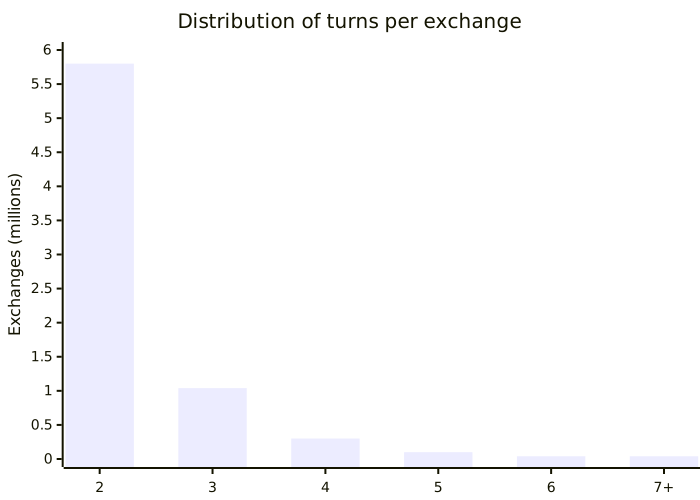
The model is fine-tuned on Discord-Dialogues: 7.3M exchanges, 17M turns, 140M words. Real Discord conversations from spring-summer 2025, filtered (PII, ToS, bots, commands). Apache 2.0.
| Metric | Value |
|---|---|
| Samples | 7,303,464 |
| Total turns | 16,881,010 |
| Total words | 139,922,950 |
| Average tokens | 32.8 |
| Tokenizer | Hermes-3-Llama-3.1-8B |
The quantized model used is a GGUF (e.g. Discord-Hermes-3-8B.Q3_K_M.gguf).

Architecture diagrams
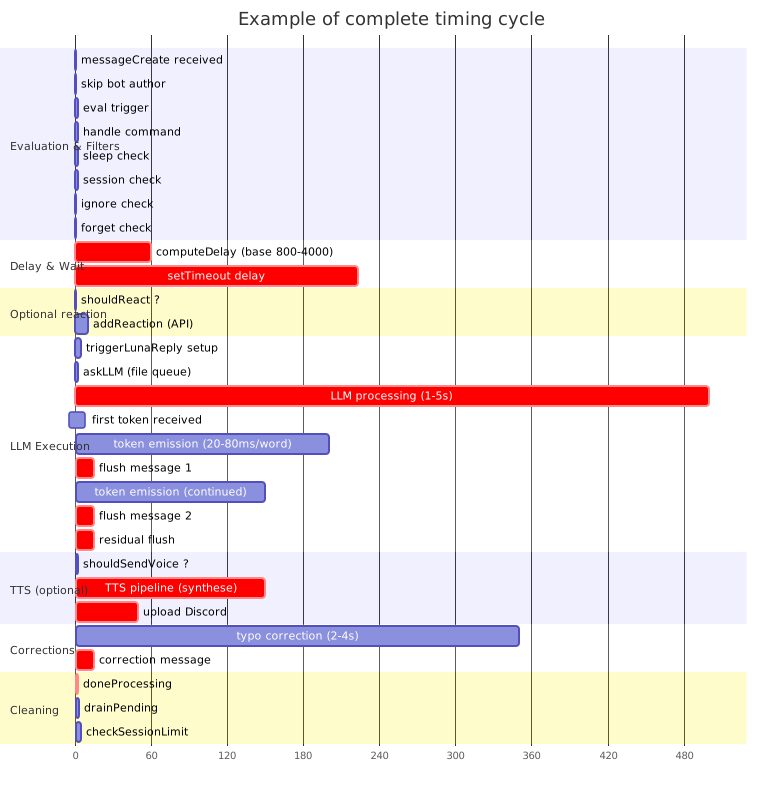
The state-machines/ folder contains 24 Mermaid diagrams covering the entire source code. Each diagram has a detailed explanation in plain language.
Among the most important:
| # | Diagram | Type |
|---|---|---|
| 01 | Architecture Overview | graph |
| 02 | Message Processing (complete) | stateDiagram |
| 03 | Trigger Evaluation | flowchart |
| 04 | LLM Core Queue (3 backends) | stateDiagram |
| 10 | TTS Pipeline | flowchart |
| 13 | State Persistence | flowchart |
| 21 | Timing Gantt | gantt |
| 22 | Complete Lifecycle | stateDiagram |
These diagrams are a goldmine for understanding the complete flow: from incoming message to response, including timers and edge cases.
The trigger code in detail
The trigger is evaluated by evaluateMessage() in state/trigger.ts. Here is the complete logic:
export function evaluateMessage(
  message: Eris.Message, botId: string, botUsername: string, isFollowUp = false
): TriggerResult {
  if (message.author.bot) return { shouldRespond: false, reason: null, botName: "" };
  if (message.content === "-stop") return { shouldRespond: true, reason: "stop", botName: "" };
  if (message.content === "-start") return { shouldRespond: true, reason: "start", botName: "" };
  if (message.content === "-clear") return { shouldRespond: true, reason: "clear", botName: "" };

  const isMentioned = message.mentions.some((u) => u.id === botId);
  if (isMentioned) return { shouldRespond: true, reason: "mention", botName };
  if (!message.guildID) return { shouldRespond: true, reason: "dm", botName };
  if (isPaused()) return { shouldRespond: false, reason: null, botName: "" };
  if (isOnCooldown(channelId)) return { shouldRespond: false, reason: null, botName };

  // ... matching by name, keyword, follow-up, random
}
The regex cache (hasWordCache) avoids recompiling patterns on every message.
Reactions
Luna reacts to messages with emojis. 30% chance to use a custom server emoji, 70% a unicode emoji. The reaction is triggered after the focus delay, not immediately.
Reaction commands on Luna's own messages:
- ❌ -> Stop
- ▶️ -> Start
- 🗑️ -> Clear
Reply style
The reply style is weighted based on Luna's recent activity in the channel:
| Context | messageReference | mentionRepliedUser | Weight |
|---|---|---|---|
| Cold | true | false | 70% |
| Cold | true | true | 20% |
| Cold | false | false | 10% |
| Active | true | false | 50% |
| Active | true | true | 15% |
| Active | false | false | 30% |
| Active | false | true | 5% |
In DMs, messageReference is always false.
Burst messages
With 15% chance, a response is split into 2-3 fragments sent at a human pace (1.5-4 seconds between each fragment). Simulates someone typing in multiple bursts.
Dynamic status
Luna's Discord status alternates between several configured presets, rotating every 15 minutes. Supported types: Playing (0), Streaming (1), Listening (2), Watching (3), Custom (4), Competing (5). During sleep, the status switches to invisible.
dynamic_status_presets:
  - status: online
    text: "with pixels"
    type: 0       # Playing
  - status: idle
    text: "white noise"
    type: 2       # Listening
A random jitter (x0.5-1.0) prevents predictable rotations. 10% of attempts are skipped to avoid repetition.
Typing indicator
Before calling the LLM, Luna calls startTyping(). A setInterval refreshes the indicator every 8 seconds during generation. Cleaned up in the finally block (clearInterval).
const startTyping = () => {
  client.sendChannelTyping(message.channel.id);
  typingIntervals.set(
    message.channel.id,
    setInterval(() => {
      client.sendChannelTyping(message.channel.id);
    }, 8000)
  );
};
Crash recovery
If the LLM crashes (llama-server process dies), Luna detects the event via llmBus.emit("crash", code) and attempts a restart with exponential backoff. Prevents infinite restart loops.
LLM parameters
The parameters are hardcoded in src/config.ts:
temp: 0.75
dynatemp-range: 0.15
top-k: 40
top-p: 0.95
min-p: 0.05
repeat-penalty: 1.12
repeat-last-n: 256
presence-penalty: 0.1
batch: 4096
ubatch: 256
context: 4096
The ChatML template (<|im_start|>/<|im_end|>) is used. The thread count is auto-detected via os.cpus().length.
Setup
npm install
cp config.example.yml config.yml
# edit config.yml
npm run dev                    # dev (hot reload)
npm run build && npm start     # production
| Script | Description |
|---|---|
build |
Standalone CLI bundle |
start |
Launches the bot |
lint / format / check |
Biome |
test |
Tests (Bun) |
download-model |
GGUF from HuggingFace |
diagrams |
Exports Mermaid diagrams to SVG/PNG |
PM2 deployment
./start.sh # launches llm-server + llm-client under PM2
Conclusion
Luna Protocol is not just a Discord bot with an LLM. It is a complete behavioral system that simulates human imperfections: forgetfulness, typos, sleep, hesitations, fatigue. All architected around a typed event bus, with 24 Mermaid diagrams documenting every flow.
The code is open source, the dataset is public, and the configuration is hot-reloadable. If the topic interests you, dive into the code -- it's more accessible than it looks.
| Resource | Link |
|---|---|
| GitHub repository | fox3000foxy/luna-protocol-project |
| Dataset | Discord-Dialogues |
| Atlas Map | atlas.nomic.ai |