
Cape Mod: how to steal Jeb_'s cape with RSA signature injection
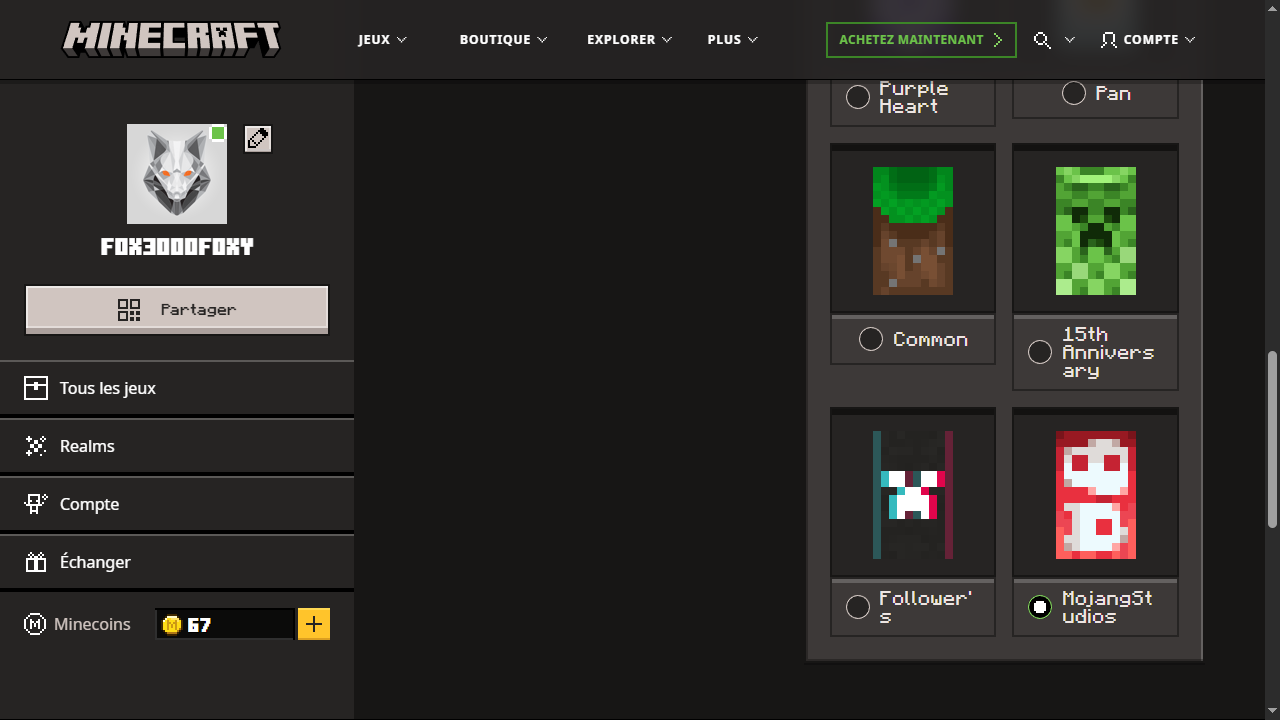 What if I told you that all it takes is a single valid RSA signature -- but for the wrong account -- to make your friends believe you're wearing the official Mojang cape? Welcome to
 cape-mod, a Fabric exploit that shows how Minecraft trusts a signature without verifying that the profile it belongs to is actually yours.
The context: how Minecraft handles skins and capes
In Java Edition, there is a question we don't often ask: who is responsible for displaying a player's skin and cape -- the client or the server?
The answer is nuanced:
| Component | Who sends it? | Who downloads it? |
|---|---|---|
| Skin texture | The server sends the signed URL | The client downloads from textures.minecraft.net |
| Cape texture | The server sends the signed URL | The client downloads from textures.minecraft.net |
textures property |
The server sends the GameProfile from Mojang auth |
The client verifies the RSA signature |
The key point: everything is contained in a property called textures of the GameProfile. This property contains:
- A base64 JSON payload with the texture URLs
- An RSA signature made with Mojang's private key
The RSA signature wall
Each textures property looks like this when decoded:
{
  "timestamp": 1783666316269,
  "profileId": "d90b68bc81724329a047f1186dcd4336",
  "profileName": "akronman1",
  "signatureRequired": true,
  "textures": {
    "SKIN": {
      "url": "http://textures.minecraft.net/texture/3e6defcb7de5a0e05c75525c6cd46e4b9b416b92e0cf4baa1e0a9e212a887f3f7"
    },
    "CAPE": {
      "url": "http://textures.minecraft.net/texture/70efffaf86fe5bc089608d3cb297d3e276b9eb7a8f9f2fe6659c23a2d8b18edf"
    }
  }
}
The client verifies the RSA signature against the public key embedded in the jar (yggdrasil_session_pubkey.der):
// Property.java (authlib)
public boolean isSignatureValid(PublicKey publicKey) {
    Signature sig = Signature.getInstance("SHA1withRSA");
    sig.initVerify(publicKey);
    sig.update(this.value.getBytes());
    return sig.verify(Base64.decodeBase64(this.signature));
}
For remote players (not local), the client only accepts skins marked as secure -- that is, with a valid signature:
// SkinManager.createLookup() -- simplified
PlayerSkin skin = optional
    .filter(ps -> !isRemote || ps.secure())  // ← remote players must be secured
    .orElse(defaultSkin);
This check prevents spoofing in theory. But that's where things get interesting.
The flaw: signature replay
The client checks that the RSA signature is valid. But it never checks whether the profileId inside the JSON matches the player's actual UUID.
In other words: a textures property taken from an existing Mojang account (for example, a Mojang employee's) can be replayed onto any other player. The signature remains valid -- it was genuinely made by Mojang -- it just came from a different account.
How to extract a genuine signature?
Jeb_ (UUID 853c80ef-3c37-49fd-aa49-938b674adae6) has the Mojang Studios cape. From the Mojang session server:
curl -s "https://sessionserver.mojang.com/session/minecraft/profile/853c80ef-3c37-49fd-aa49-938b674adae6?unsigned=false"
Response:
{
  "id": "853c80ef-3c37-49fd-aa49-938b674adae6",
  "name": "jeb_",
  "properties": [
    {
      "name": "textures",
      "value": "ewogICJ0aW1lc3RhbXAiIDogMTc4MzYxOTcyNjAxMSwKICAicHJvZmlsZUlkIiA6ICI4NTNjODBl...",
      "signature": "RgIPF4d/iTDWJV..."
    }
  ]
}
The signature of this value field was produced by Mojang. It's RSA-2048 SHA-1. It is absolutely valid, even if you replay it on another UUID -- because Jeb_'s signature remains Jeb_'s signature, and the client never checks that it's supposed to be yours.
The code: how the mod works
The cape-mod mod is tiny -- 65 lines of Java. Here is the core:
@Mixin(Player.class)
public class ServerPlayerMixin {
    private static final String TEXTURES_VALUE =
        "ewogICJ0aW1lc3RhbXAiIDogMTc4MzY2NjMxNjI2OSwKICAicHJvZmlsZUlkIiA6ICJkOTBi...";

    private static final String TEXTURES_SIGNATURE =
        "oxoAfZRLVNSfXYFMNbDKZ9XxrTHmz/k2yxzOxksXY3f6aDhY3gCyFCCtDreEWI7fpG9...";

    @Inject(method = "getGameProfile()Lcom/mojang/authlib/GameProfile;",
            at = @At("RETURN"), cancellable = true)
    private void injectCape(CallbackInfoReturnable<GameProfile> cir) {
        Player self = (Player) (Object) this;
        if (!(self instanceof ServerPlayer serverPlayer)) return;
        MinecraftServer server = ((ServerPlayerAccessor) serverPlayer).getServer();
        if (!(server instanceof IntegratedServer)) return;

        GameProfile host = server.getSingleplayerProfile();
        GameProfile original = cir.getReturnValue();
        if (host == null || !host.name().equals(original.name())) return;

        // Replace the textures property with Jeb_'s
        ImmutableMultimap.Builder<String, Property> b = ImmutableMultimap.builder();
        for (Property p : original.properties().values()) {
            if (!p.name().equals("textures")) {
                b.put(p.name(), p);
            }
        }
        b.put("textures", new Property("textures", TEXTURES_VALUE, TEXTURES_SIGNATURE));
        cir.setReturnValue(new GameProfile(original.id(), original.name(),
                                           new PropertyMap(b.build())));
    }
}
Steps:
- Mixin on
Player.getGameProfile()-- the point where the player's profile is returned - Check that this is a local server (Integrated Server)
- Check that this is the host (LAN world)
- Replace the
texturesproperty with Jeb_'s (hardcoded) - Return a new
GameProfilewith the injected textures
The GameProfile is therefore forged: it is an artificially constructed profile that does not correspond to the real player. The textures properties are replayed from Jeb_ -- the RSA signature is authentic but applied to the wrong profile. The network packet, however, is legitimate: the server normally sends the ClientboundPlayerInfoUpdatePacket with this modified profile. It is the profile that is forged, not the packet.
When the host's friends join via LAN, they receive the ClientboundPlayerInfoUpdatePacket with the modified profile. The client:
- Decodes the base64 payload
- Verifies the RSA signature -- ✅ valid (it's genuinely Jeb_'s)
- Marks the skin as
secure=true(because the signature is valid) - Passes the
!isRemote || ps.secure()filter -- ✅ passes - Downloads and displays Jeb_'s cape
In-game result: the cape on your skin
Here's what it looks like in-game. First, a front view with Jeb_'s cape displayed on the host:
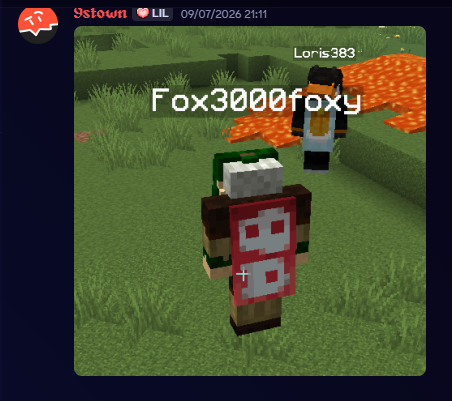
You can clearly see the red/white pattern of the official Mojang Studios cape. No difference from a real Jeb_ who has his own cape -- the client downloads exactly the same texture from textures.minecraft.net.
And in immersive view, in an actual game:
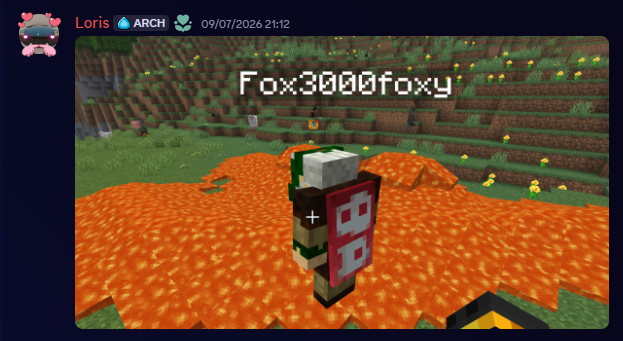
The cape floats behind the player, waving with movement. Perfectly indistinguishable from an authentic skin with an official cape.
Another angle, in a world with lava and terrain:
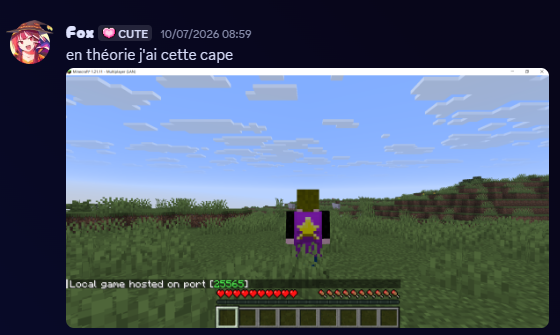
And one last close-up view of actual gameplay, showing the cape in action:
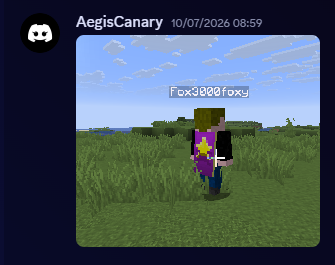
For someone joining a LAN without knowing the host has a mod, there is absolutely no way to distinguish this from a real Mojang cape. That's precisely the point: the signature is valid, the client has no reason to doubt.
Why this is a flaw (and why it isn't)
It's ironic: the exploit works precisely because the signature is valid. There is no cryptographic bypass here -- it's worse, it's a logical flaw in the trust model.
| Check | Result |
|---|---|
| RSA signature validity | ✅ Valid (signed by Mojang for Jeb_) |
Does the profileId in the payload match the host's UUID? |
❌ No (Jeb_'s UUID != host's UUID) |
| Does the client verify the match? | ❌ No. Only the RSA signature is verified. |
Minecraft trusts the signature, not the identity of who carries it. As long as the signature comes from Mojang, the client accepts it. It's like showing a fake passport signed by the government -- the seal is legitimate, even though the passport doesn't belong to you.
Security implications
Limited scope to LAN
The mod only works on an integrated server (LAN). The attacker must:
- Have a Fabric mod installed
- Be the host of a LAN world
- Friends connect without a mod (vanilla)
But the possibilities go further
In theory, with the same technique, one could:
- Reinject other signed data: heads, illegal enchantments, malicious chat components
- Combine with a LAN tunnel (NGROK, playit.gg, Radmin VPN) to affect players over the internet
- Extend to other profile properties that rely on signatures
Why Mojang probably won't patch this
There is no "vulnerability" in the strict sense -- the signature is valid. Patching this would require Mojang to change the entire authentication model, which is complex. For now, it's an edge case: LAN players are assumed to trust each other.
The philosophical trap
Cape Mod is an excellent proof of concept of a broader truth: you must never trust a signature without verifying who signed it and for what subject.
It's a lesson in basic cryptography. RSA signs a message, not an identity. If I give you a valid RSA signature from Mojang, you know that Mojang has signed something. You don't know for whom, and you can't assume it just by looking at the message.
This is exactly what happened with SSL/TLS certificates in the 2000s when CAs would sign anything -- the signature was valid, but it applied to the wrong domain.
Conclusion
Cape Mod is not a hack in the classic sense -- it is an elegant exploitation of a missing validation check in Minecraft. It shows that:
- A valid signature does not guarantee the identity of the person carrying it
- On LAN, trust is weaker than we believe
- Minecraft's
texturesproperties are essentially injected content -- they must be checked to match the player who carries them
If you join a LAN world on an "unknown" server (or rather, one whose host has a suspicious mod), you already have a security problem well before the cape. But it's symptomatic: Minecraft assumes everyone on a LAN trusts each other. That's true... until it isn't.
Resources
- GitHub: fox3000foxy/cape-mod
- Minecraft auth: Yggdrasil protocol (wiki.vg)
- RSA cryptography: RFC 3447 (PKCS #1)
3 key points
- RSA signatures validate a message, not an identity -- a detail that has cost many systems dearly.
- Minecraft does not check that the player's profile matches the signature it receives -- a logical flaw, not a cryptographic one.
- On LAN or through a tunnel, anything goes for a mod that controls the integrated server.